
EIFS Inspection Services in Portland, OR & Vancouver, WA
Specialized moisture testing for Exterior Insulation and Finish Systems (EIFS) to identify hidden water intrusion and potential damage.
Exterior Insulation and Finish System (EIFS), also known as synthetic stucco, is an exterior wall cladding system used on commercial and residential buildings. It was introduced in Europe following WWII and originally used over existing masonry walls, reaching the American market in the 1960s. It saw relatively little use outside commercial masonry applications until the 1980s, when it became popular on higher-end homes and was installed over wood-framed construction.
The idea is to add energy-efficient insulation to the exterior of the building and finish it with a thin mesh and cementitious coat, which also produces an attractive stucco appearance. The problem is that when EIFS is applied over wood framing and not detailed properly, water gets behind the system and becomes trapped. Water trapped behind EIFS on a wood-framed building causes rot, mold and fungus, and insect infestation. Many faulty or aging installations let water in with no way to drain, causing extensive damage to the structure.
What Is an EIFS Inspection?
An EIFS inspection is a visual, non-invasive inspection followed by invasive moisture probing at selected areas. We start with a visual inspection of the EIFS system and its associated components — windows, decks, doors, and flashing — and then perform invasive moisture testing at locations chosen during that visual review.
It is very important to understand that without invasive moisture probing there is no way to know the condition of the underlying wall structure. When we quote this inspection, customers who have already called around are sometimes surprised at the price. Our next question is always: are the other companies doing a visual inspection plus invasive moisture probing? Infrared, non-invasive moisture meters, and visual inspection alone are not adequate and do not tell you the condition of the wall structure behind the EIFS. EIFS often looks great on the surface while hiding significant damage below.
The EIFS Inspection Process
During the initial visual and non-invasive portion, we review the entire installation up close and at a distance, looking for clues of improper installation, damage, failed sealants, missing or damaged flashings, and more. We focus on the areas surrounding windows, flashings, at and below roof diverters (also called kickout flashing), at every penetration through the system, and anywhere the system is too close to or buried in ground cover.
Windows are heavily scrutinized for possible water entry points such as failed sealant joints, leaky or open miter joints, and blocked weep holes. Windows are the most common water entry point: the average house has roughly 10–15 of them, and EIFS-clad homes — which tend to be larger and upper scale — often have many more. We have inspected EIFS homes with 30 or more windows.
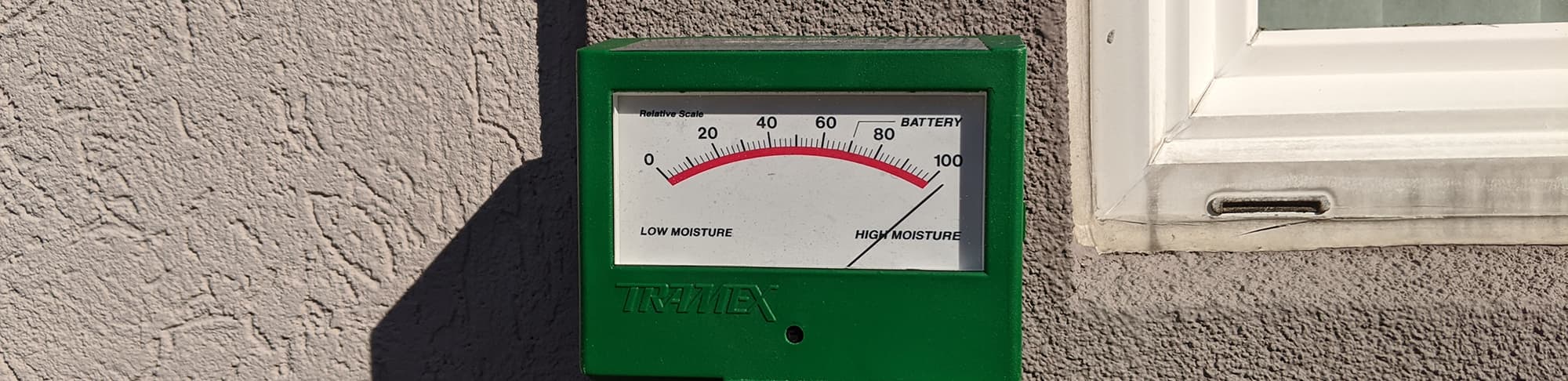
We also use a non-invasive Tramex moisture meter designed specifically for EIFS to search for elevated moisture below the surface. The meter is first calibrated to a known dry area, then used to compare relative moisture indications and identify where the wall should be probed. Suspect areas are scanned at and below windows, at penetrations, at cracking, and below kickout and diverter flashings. A Tramex reading on its own is not proof that an area is wet or damaged; only invasive moisture testing can verify that.
Before any moisture testing or probing, we require a minimum of 12 hours of dry weather so that recent rain does not interfere with accurate readings. The visual portion of the inspection can be done in any weather.
EIFS Moisture Testing and Probing
At the areas selected during the visual inspection, we follow on with moisture probing. Two small ¼-inch holes are drilled through the EIFS surface at each test site, and moisture probes are inserted through the surface and insulation back to the wall sheathing to check both the moisture level and the firmness of the sheathing. Written permission from the homeowner is always required before any invasive probing.
Moisture readings are recorded for the report, along with whether the wall structure behind the foam feels firm and sound or soft and decayed. Firmness is checked by using the probe to feel for soft or decayed areas. In some cases the sheathing can be dry at the time of inspection and still contain decay, which is why both measurements matter.
The holes are then sealed with sealant matched as closely as possible to the house color, and where we can we probe under ledges to hide the locations further. Once filled, the holes are generally not easy to find again unless you know where to look. Moisture probe locations, moisture content readings, and any damage detected are all included in the written report.
What the EIFS Report Includes
We provide as much detail about the system as possible, both to help you make informed decisions about the property and to guide EIFS repair contractors performing maintenance and repairs. The written report documents any deficiencies found, including:
- Failed, cracking, or gapping sealant
- Areas with inadequate clearance from ground cover or hardscape
- Vegetation clearance issues
- Improperly installed EIFS materials
- Missing or improper flashing
- Improperly sealed penetrations
- Areas of moisture probing and the readings taken
- Any areas of decay or damage discovered
Do You Need an EIFS Inspection?
EIFS inspections matter for several reasons:
- Moisture intrusion detection: EIFS that is not properly installed or maintained is susceptible to water infiltration, which leads to mold growth, degradation of the insulation, and damage to the building structure.
- System integrity: an inspection assesses the overall condition of the system, checking for damage, cracks, or areas where it has been compromised. Addressing issues early prevents more extensive and costly repairs later.
- Insurance and lending requirements: some insurance providers and lenders require an EIFS inspection as part of their due diligence before issuing coverage or financing.
- Property transactions: if you are buying or selling a property with EIFS, an inspection provides real information about the condition of the cladding and lets issues be addressed before the sale is finalized.
- Preventive maintenance: EIFS manufacturers recommend professional inspection over and above homeowner diligence. Catching minor issues early extends the life of the system.
Other Services
Stucco Inspection
Thorough stucco moisture testing and visual inspection to detect water intrusion, improper installation, and structural concerns.
Stone Veneer Inspection
Specialized inspection for manufactured stone veneer, checking for proper installation, moisture barriers, and water intrusion issues.
Home Inspections
Our comprehensive home inspections cover all major systems and components of your home, giving you the information you need to make confident decisions.
Roof Inspection
Detailed roof inspections covering materials, flashing, gutters, ventilation, and overall condition to help you understand the state of your roof.

Ready to Schedule Your Inspection?
Our certified inspectors are ready to help protect your investment.